Buyer's Guide · Last updated July 14, 2026
Best Construction Submittal Software 2026: 7 Tools Compared
We compared seven submittal tools on AI capability, package assembly, compliance checking, and price — from $150/month trackers to $80k/year enterprise platforms. Here's the short answer, then the detail.
The quick answer
- 1
Submittal.app — Best for subcontractors & suppliers. An AI agent builds the entire package — products, cutsheets, comments, quotes, and POs — from one plain-English prompt.
- 2
Procore — Best for enterprise GCs. The most complete project-management platform; submittals are one module of many.
- 3
Autodesk Construction Cloud — Best for BIM-heavy teams. Deep Revit/AutoCAD integration ties submittals to models and design workflows.
- 4
Pype AutoSpecs — Best for submittal log extraction. Reads spec books and auto-generates the submittal log and closeout requirements.
- 5
BuildSync — Best for AI compliance review. Acts as an automated reviewer inside Procore workflows, checking packages against spec.
- 6
SubmittalLink — Best budget pick for small GCs. Published flat pricing from $150/month with unlimited users and projects.
- 7
Constructable — Best Procore alternative. Flat-rate pricing with unlimited users and connected submittals, RFIs, and comms.
How we compared them
Criteria: depth of AI automation (does it build, review, or just track?), cutsheet and product-data handling, procurement follow-through (quotes/POs), pricing transparency, and who the tool actually fits. Sources: vendor documentation and published pricing pages, plus third-party pricing analyses and review platforms (G2, Capterra, ITQlick, TrustRadius) — linked in the proof section below. Author: the Submittal.app team. Disclosure:Submittal.app is our product. We ranked it first for the workflow it's built for — subs and suppliers assembling packages — and we've been explicit below about where a different tool is the better choice. Last updated: July 14, 2026.
Comparison at a glance
| Tool | Best for | Key strength | Main limit | Pricing |
|---|---|---|---|---|
| Submittal.app | Subs & suppliers | AI agent assembles the full package, then the quote and PO | Focused workflow tool, not a full PM suite | Free to start; usage-based plans |
| Procore | Enterprise GCs | End-to-end platform: bidding to closeout | Cost scales with construction volume | Custom; ~$15k–$80k/yr reported |
| Autodesk Construction Cloud | BIM-centric teams | Model-linked documents and approvals | Most value only inside the Autodesk ecosystem | Per-product subscription |
| Pype AutoSpecs | Submittal logs | AI extracts the log from spec books | Builds the log, not the package | Quote-based; ~$50–$150/user/mo reported |
| BuildSync | Compliance review | AI reviews packages against spec in Procore | A reviewer, not a builder; Procore-tied | Custom quote |
| SubmittalLink | Small GCs | Simple, cheap, unlimited users | Lighter AI; submittal-specific scope | $150–$250/mo published |
| Constructable | Procore switchers | Flat rate, unlimited users, connected workflows | Generalist PM tool; submittals less specialized | Flat-rate subscription |
The 7 tools in detail
1. Submittal.app
Best for: Subcontractors, distributors, and suppliers who want the package built for them — not just tracked.
Key features
- Submittal Builder agent: describe the job in plain language and it finds products, pulls manufacturer cutsheets, and assembles the package while you watch
- Three working modes — Create (new submittals, quotes, POs), Manage (find and edit what exists), Review (compare to spec, summarize comments)
- Multi-source cutsheet search (Google, Exa, TinyFish) with extracted specs and confidence scores
- Review comments auto-placed on the exact spot on each cutsheet; one-command product swaps keep part numbers in sync
- Approved package converts to a quote or PO without re-entering data; POs grouped by manufacturer
- Share packages with a secure link — reviewers don't need an account
Limits
- Purpose-built for the submittal-to-procurement workflow — it is not a full project-management platform (no scheduling, budgeting, or field management)
- Newer platform than the enterprise incumbents
Pricing: Free to get started; paid plans scale by usage (products, submittals, AI extractions). No construction-volume-based fees.
Choose Submittal.app if the bottleneck is the hours your team spends assembling packages, chasing cutsheets, and re-typing the same data into quotes and POs.
2. Procore
Best for: Large general contractors that want one platform for everything from bidding to closeout.
Key features
- Submittals module connected to RFIs, drawings, scheduling, and financials
- Mature approval workflows, distribution lists, and ball-in-court tracking
- Huge marketplace of integrations (including AI reviewers like BuildSync)
Limits
- Pricing is based on Annual Construction Volume — third-party analyses report roughly $15k–$80k/year for small-to-mid GCs, with renewal increases common
- Submittals are one module among dozens; the AI assembly work still falls to your team
Pricing: Custom, ACV-based annual contracts. Independent analyses estimate ~0.1–0.2% of construction volume.
Choose Procore if you're an established GC that needs the full operations platform and the budget matches your volume.
3. Autodesk Construction Cloud
Best for: Design-build firms and BIM-heavy teams already working in Revit and AutoCAD.
Key features
- Submittal workflows tied directly to models, sheets, and issues
- AI-assisted document extraction feeding approval workflows
- Strong version control across design iterations
Limits
- The ecosystem advantage only materializes if you're already an Autodesk shop
- Package assembly and cutsheet sourcing remain manual
Pricing: Per-product subscriptions; BIM authoring tools licensed separately.
Choose ACC if drawings and models are your source of truth and you want submittals living next to them.
4. Pype AutoSpecs (Autodesk)
Best for: GCs who want the submittal log generated from the spec book automatically.
Key features
- AI reads specs to extract action submittals, product data, closeout items, and tests/inspections
- Version tracking flags changed requirements across design iterations
- Integrates with Procore, BIM 360, CMiC, Viewpoint, and others
Limits
- Produces the log and requirements — assembling the actual packages is out of scope
- No published pricing; no free trial per review sites
Pricing: Quote-based; third-party estimates report ~$50–$150 per user per month.
Choose Pype if your pain is the week of manual spec reading at project start, not the package assembly afterward.
5. BuildSync
Best for: GCs on Procore who want AI to review incoming submittals against spec.
Key features
- Submittals route to BuildSync for automated technical analysis and return with compliance reports and markups
- Vendor-reported results: first-time approval rates up to 95%, review time cut by up to 80%
Limits
- It reviews packages others built — it doesn't help subs create them
- Designed around Procore workflows
Pricing: Custom quote.
Choose BuildSync if rejected submittals are your biggest cost and your workflows already live in Procore.
6. SubmittalLink
Best for: Small GCs and local builders who need the basics at a fair price.
Key features
- Published pricing: $150/mo (under $5M volume), $250/mo ($5–25M), enterprise custom
- Unlimited projects, users, and storage on every tier
Limits
- AI capabilities are lighter than the dedicated AI tools on this list
- Scope is submittal tracking, not assembly or procurement
Pricing: $150–$250/month published; enterprise custom.
Choose SubmittalLink if you mainly need organized submittal tracking without enterprise pricing.
7. Constructable
Best for: Teams leaving Procore over cost or complexity.
Key features
- Submittals connected to RFIs and project communication in one system
- Unlimited users with no per-seat fees; minimal training required
Limits
- A general PM tool — submittal-specific AI depth is limited
Pricing: Flat-rate subscription with unlimited users.
Choose Constructable if Procore's pricing model is the problem and you want simpler, connected project workflows.
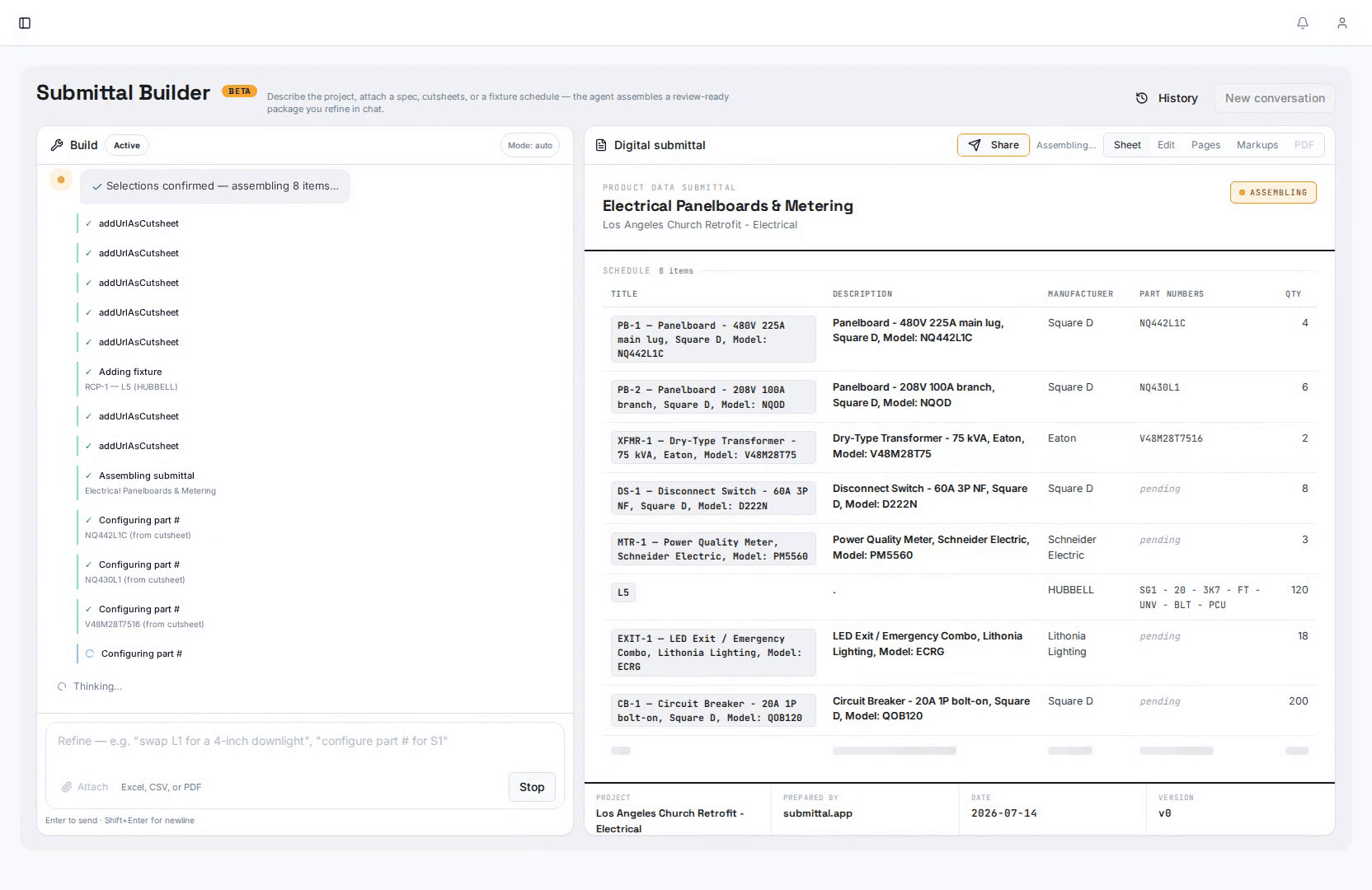
Submittal.app's Builder agent assembling an electrical package — every product, cutsheet, and header placed from one prompt.
Which one should you choose?
- Choose Submittal.appif you're a sub, distributor, or supplier and package assembly is the time sink — you want the AI to build, quote, and order, not just track.
- Choose Procoreif you're an enterprise GC that needs the whole operations platform and can absorb volume-based pricing.
- Choose Autodesk Construction Cloud if your projects live in Revit/AutoCAD and model-linked workflows matter more than assembly automation.
- Choose Pype AutoSpecs if generating the submittal log from a 900-page spec book is the pain.
- Choose BuildSync if you receive packages and rejected submittals are costing you review cycles.
- Choose SubmittalLink or Constructable if predictable flat pricing beats feature depth for your team size.
- Avoid enterprise platformsif you only need the submittal workflow — you'll pay for modules you never open. Avoid tracking-only toolsif your team still assembles packages by hand — tracking a slow process doesn't make it faster.
The numbers behind this guide
- A rejected submittal costs roughly $805 per rejection in rework and delay, per BuildSync's cost analysis.
- Procore's fees typically run 0.1–0.2% of annual construction volume — roughly $15k–$80k/year for small-to-mid GCs — per ScanManifold's 2026 pricing breakdown.
- Pype AutoSpecs pricing is unpublished; third-party estimates put it at $50–$150 per user per month, per ITQlick.
- SubmittalLink publishes its pricing — $150/month under $5M volume, $250/month to $25M — on its site.
Frequently asked questions
What does construction submittal software do?
It manages the process of submitting product data, shop drawings, and samples for approval before construction. Depending on the tool, that ranges from tracking who has the ball (Procore, SubmittalLink) to generating the submittal log from specs (Pype AutoSpecs), AI-reviewing packages for compliance (BuildSync), or assembling the entire package automatically (Submittal.app).
Can AI actually build a submittal package, or just track it?
As of 2026, yes — agent-based tools can build packages. Submittal.app's Submittal Builder takes a plain-English request like "build a submittal for all the L-type fixtures in this project," finds the products, pulls manufacturer cutsheets from the web, assembles per-fixture headers, adds cover pages and transmittals, and produces a shareable PDF. Most other tools automate one step (log extraction or compliance review) rather than the assembly itself.
How does AI find manufacturer cutsheets?
Multi-source search. Submittal.app, for example, queries Google (open web), Exa (semantic search that works with partial product info), and TinyFish (a product database with extracted specs like wattage, voltage, lumens, CCT, and CRI, plus confidence scores) simultaneously, then attaches the chosen datasheet to the product record.
Can submittal software also handle quotes and purchase orders?
Some can. Submittal.app converts an approved package into a quote (line items, quantities, documented pricing, optional markup) and then into purchase orders grouped by manufacturer — without re-entering data. Platforms like Procore handle procurement in separate financial modules; tracking-focused tools generally don't.
How much does construction submittal software cost in 2026?
The range is wide. Published pricing starts around $150/month (SubmittalLink). Per-user tools reportedly run $50–$150/user/month (Pype AutoSpecs). Enterprise platforms are volume-based — independent analyses put Procore at roughly $15k–$80k/year for small-to-mid GCs. Submittal.app is free to start with usage-based paid plans.
Do reviewers need an account to review a submittal package?
Not with share-link tools. Submittal.app generates a secure review link so GCs, architects, and manufacturer reps can view and comment on the package without creating an account. Enterprise platforms typically require licensed seats or collaborator accounts.
What's the difference between submittal log software and submittal builder software?
Log software (like Pype AutoSpecs) reads the spec book and tells you what you must submit. Builder software (like Submittal.app) does the downstream work: finding the actual products and cutsheets, assembling the package, placing review comments, and generating the quotes and POs that follow approval. Many teams need one or the other; large GCs sometimes use both.
See the Builder agent work on your project
Free to start — describe a job and watch the package assemble.